Shimaoka Tatsuzo
1917–2007Living National Treasure, Jōmon-zōgan
Shimaoka Tatsuzo was one of the great successors to the Mashiko pottery tradition. Born in Tokyo in 1917, he studied ceramics and then apprenticed under Hamada Shoji, whose example shaped his understanding of craft, discipline and the Mingei ideals he would carry for the rest of his career. After his apprenticeship Shimaoka established his own kiln and workshop in Mashiko — close to Hamada’s world, but with a visual language distinctly his own.
He became known above all for Jōmon-zōgan, a rope-impressed inlay technique that joins one of Japan’s most ancient surface traditions to modern studio pottery. Cords are rolled into the soft clay to leave an impressed pattern, which is then inlaid with contrasting slip; the result is a surface that feels at once archaeological and alive. It gave Shimaoka’s work an immediately recognisable identity — tactile, patterned, structured, and deeply tied to the long history of Japanese ceramic making.
The Shimaoka works in this collection include sake cups, a tea cup with its signed wood storage box, rope-patterned dishes and inlaid boxes and covers. They reward close looking. Where Hamada works in bold brush and poured glaze, Shimaoka builds a field of texture and repetition — impressed cord, inlaid slip, the steady rhythm of stamped pattern across green, tenmoku and iron-rust glazes.
In 1996 Shimaoka was himself designated a Living National Treasure, recognised for his ceramic achievement and in particular for his command of rope-impressed inlay. His work has been exhibited internationally and is held in major collections. For collectors he offers a powerful continuation of the Mashiko story: a student of Hamada who honoured the tradition while developing one of the most recognisable ceramic techniques of his generation.
What to look for
Run your eye across the surface. The impressed cord patterns and inlaid slip are the signature — Jōmon-zōgan — and the interest lies in how Shimaoka organises them: a single bold circle, six small roundels, a radial burst, framed by green, tenmoku and kaki glazes. On the finest pieces the impressed artist’s mark “Ta” appears at the base, and original signed storage boxes add to provenance.
Signature techniques
- Jōmon-zōgan (rope-impressed inlay)
- Slip inlay
- Stamped and impressed pattern
- Tenmoku
- Kaki (iron-rust) glaze
- Green glaze
- Press-moulded stoneware
Living National Treasure (1996) · Master of Jōmon-zōgan · Apprentice and heir to the Hamada / Mashiko lineage
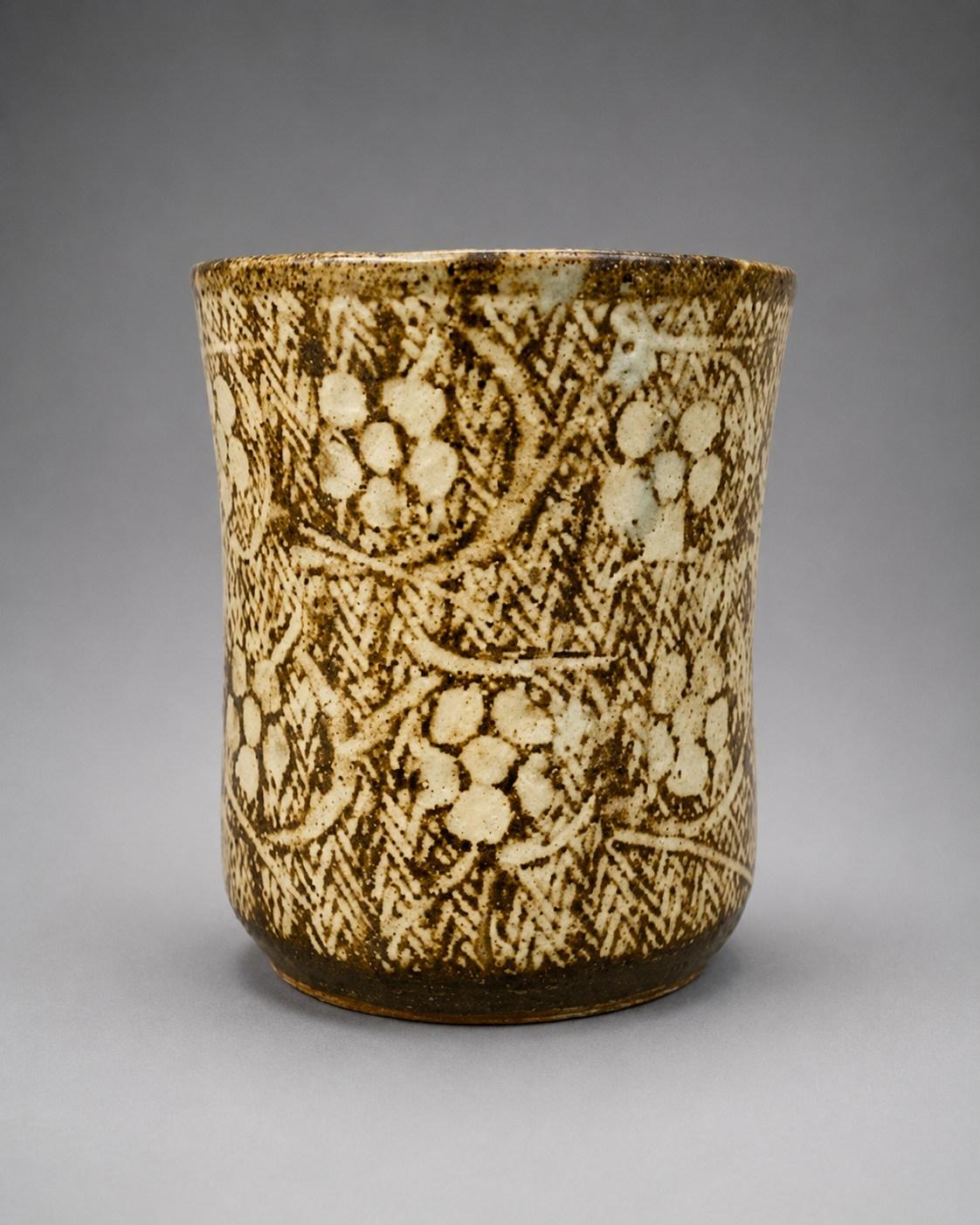
A Stoneware Vase
Shimaoka Tatsuzo
![Shimaoka Tatsuzo — Chawan / Tea Bowl. A Stoneware chawan [tea bowl], Japanese stoneware, Showa period, 20th century.](/_next/image?url=%2Fimages%2Fworks%2Fshimaoka-tatsuzo-stoneware-chawan-tea-bowl-byft8.jpg&w=3840&q=75)
A Stoneware chawan [tea bowl]
Shimaoka Tatsuzo
![Shimaoka Tatsuzo — Sakazuki / Sake Cup. A Stoneware sakazuki [sake cup], Japanese stoneware, Showa period, 20th century.](/_next/image?url=%2Fimages%2Fworks%2Fshimaoka-tatsuzo-stoneware-sakazuki-sake-cup-byft9.jpg&w=3840&q=75)
A Stoneware sakazuki [sake cup]
Shimaoka Tatsuzo
![Shimaoka Tatsuzo — Sakazuki / Sake Cup. A Stoneware sakazuki [sake cup], Japanese stoneware, Showa period, 20th century.](/_next/image?url=%2Fimages%2Fworks%2Fshimaoka-tatsuzo-stoneware-sakazuki-sake-cup-byftb.jpg&w=3840&q=75)
A Stoneware sakazuki [sake cup]
Shimaoka Tatsuzo
![Shimaoka Tatsuzo — Sakazuki / Sake Cup, grasses. A Stoneware sakazuki [sake cup] with Grasses Motif, Japanese stoneware, Showa period, 20th century.](/_next/image?url=%2Fimages%2Fworks%2Fshimaoka-tatsuzo-stoneware-sakazuki-sake-cup-grasses-motif-byftc.jpg&w=3840&q=75)
A Stoneware sakazuki [sake cup] with Grasses Motif
Shimaoka Tatsuzo
![Shimaoka Tatsuzo — Yunomi / Tea Cup, rope-impressed inlay. A Stoneware yunomi [tea cup] with Inlaid Rope Pattern, Japanese stoneware, Showa period, 20th century.](/_next/image?url=%2Fimages%2Fworks%2Fshimaoka-tatsuzo-stoneware-yunomi-tea-cup-inlaid-rope-pattern-byftd.jpg&w=3840&q=75)
A Stoneware yunomi [tea cup] with Inlaid Rope Pattern
Shimaoka Tatsuzo